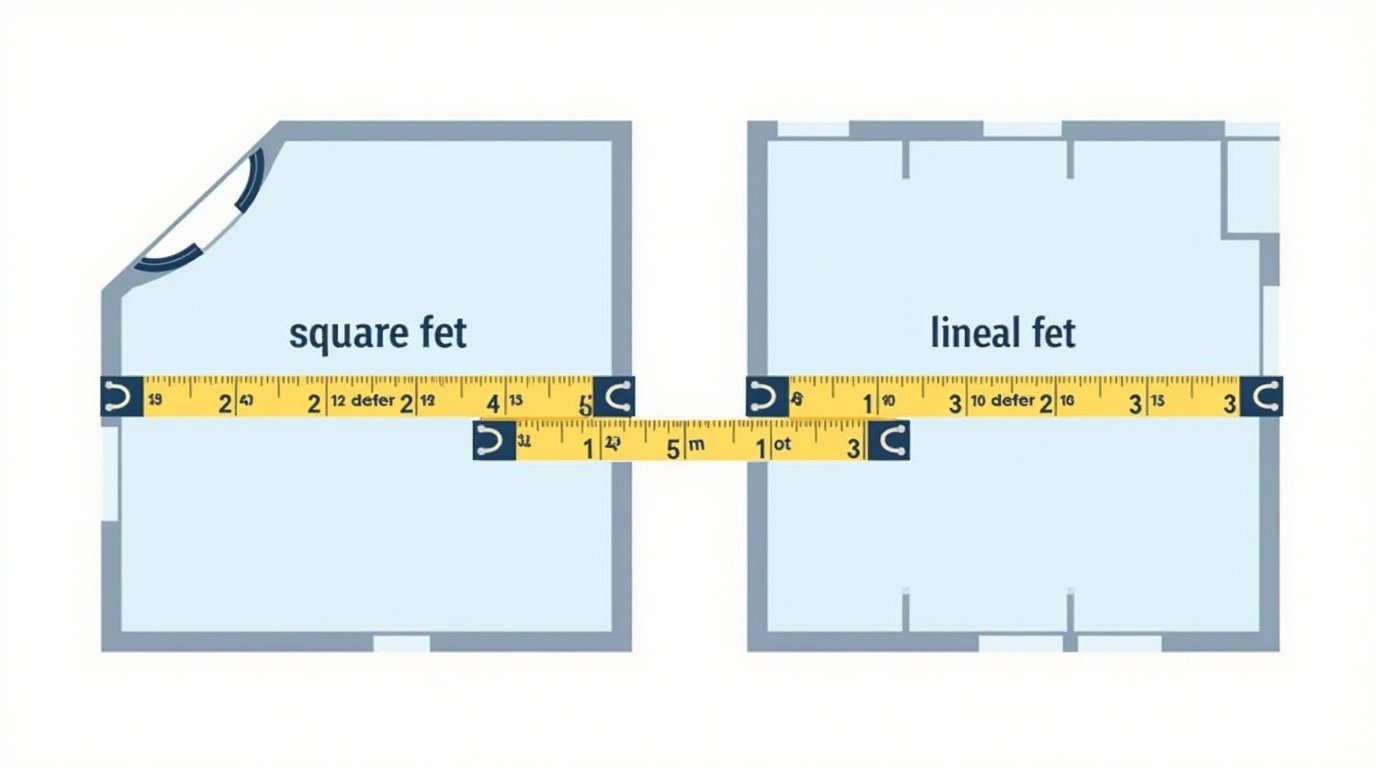
When tackling any remodeling project, flooring work, or construction job, one of the most common questions people ask is: “How do I calculate linear feet from square feet?” Whether you’re buying wood trim, fencing panels, countertops, carpets, or baseboards, suppliers often price their products in linear feet. On the other hand, customers usually measure spaces in square feet. This can create confusion if you don’t know how to convert between the two measurements.
This article provides a step-by-step process to calculate linear feet from square feet, explains the key differences between these two units, shares practical examples, and answers the most frequently asked questions about this topic. By the end, you’ll be confident in making accurate conversions and cost estimations for your projects.
What Are Square Feet?
A square foot (sq ft) is a unit of area that measures the surface of a two-dimensional space. One square foot equals a square that is one foot wide and one foot long. It is commonly used in the United States to measure:
- Room sizes
- Flooring materials
- Real estate property areas
- Wall surfaces for painting or tiling
The formula for square feet is : Square Feet=Length (ft)×Width (ft)Square Feet=Length (ft)×Width (ft)
For example, if a room is 12 feet long and 10 feet wide:12 ft×10 ft=120 sq ft12ft×10ft=120sqft
So the total room area is 120 square feet.
What Are Linear Feet?
A linear foot (lin ft) is simply a measurement of length in feet. It does not account for width or height. One linear foot equals 12 inches measured along a straight line. It is used when you need to calculate materials that are sold or installed based on length, including:
- Lumber
- Baseboards
- Countertops
- Fencing
- Molding or trim
- Carpet or flooring rolls
For example:
- A 10-foot-long board is 10 linear feet, regardless of its width.
- A fence stretching 100 feet along property lines equals 100 linear feet.
The Relationship Between Square Feet and Linear Feet
Here’s the key difference:
- Square feet measures area (length × width).
- Linear feet measures straight length only.
To convert square feet into linear feet, you need one crucial piece of additional information: the width of the material being measured.
The formula to convert is:Linear Feet=Square FeetWidth (in feet)Linear Feet=Width (in feet)Square Feet
This is because dividing total area (sq ft) by the known width gives you the total length (linear feet) needed.
Step-by-Step Method to Calculate Linear Feet from Square Feet
Step 1: Measure the Square Footage
First, measure the total square footage of the area. For example:
- A living room that measures 15 feet by 20 feet:
15×20=300 sq ft15×20=300sqft
Step 2: Identify the Width of the Material
You need to know how wide the material is that you’ll be installing. Common examples:
- Baseboards: usually 0.5 ft wide (6 inches)
- Carpet rolls: commonly 12 ft wide
- Countertops: often 2 ft wide
Step 3: Apply the Conversion Formula
Use the conversion formula:Linear Feet=Square FeetWidth (in feet)Linear Feet=Width (in feet)Square Feet
Step 4: Final Answer
Round up your results since most suppliers don’t cut partial feet.
Real-Life Examples
Example 1: Carpet
You want to cover a 240-square-foot room with carpet, but the carpet roll comes in 12-foot widths.Linear Feet=24012=20 linear feetLinear Feet=12240=20linearfeet
You’ll need 20 linear feet of carpet.
Example 2: Countertops
A kitchen countertop area is 48 square feet. The countertop slab width is 2 feet.Linear Feet=482=24 linear feetLinear Feet=248=24linearfeet
You’ll need 24 linear feet of countertop slab.
Example 3: Baseboard Trim
A room measures 15 by 20 feet, so the floor area is 300 sq ft. But if you want trim molding, you don’t convert area—you calculate perimeter instead:Perimeter=2×(Length+Width)=2×(15+20)=70 linear feetPerimeter=2×(Length+Width)=2×(15+20)=70linearfeet
So you’d need 70 linear feet of trim.
Common Mistakes to Avoid
- Forgetting material width: You must always know the width to convert sq ft into linear feet.
- Confusing perimeter with area: For trims, moldings, or fencing, you should calculate perimeter, not square footage.
- Not rounding up: Suppliers usually sell in full linear feet. If you get 19.6 feet, purchase 20.
- Overlooking waste factor: Add 5–10% extra for cutting wastage.
Why This Conversion Matters
- Budgeting: Knowing linear feet helps you calculate the correct material cost.
- Avoiding shortages: Prevents under-purchasing, which can delay projects.
- Project precision: Ensures accurate estimates for contractors and homeowners.
- Supplier accuracy: Most stores price lumber, flooring, and trims per linear foot.
Tools and Calculators
To speed up conversions, you can use:
- Online linear feet calculators
- DIY spreadsheets (Excel/Google Sheets)
- Construction apps for flooring and lumber estimation
But knowing the manual formula makes you independent and prevents errors.
Frequently Asked Questions (FAQs)
1. How many linear feet are in a square foot?
A square foot cannot directly equal a linear foot without knowing the width. The formula is:
Linear Feet = Square Feet/Width (feet)Linear Feet=Width (feet)Square Feet
2. How do I calculate linear feet for baseboards?
For baseboards, calculate the perimeter of the room (2 × (length + width)) instead of using the square footage.
3. Is linear feet the same as square feet?
No. Square feet measures area (length × width). Linear feet only measures straight length.
4. How do contractors calculate material cost with linear feet?
Contractors multiply the linear feet required by the supplier’s price per linear foot, adding extra for waste and installation.
5. Can I convert square feet to linear feet without width?
No. Width is essential. Without it, conversion is impossible because both units measure different dimensions.
Tips for Accurate Measurement
- Use a laser measure or measuring tape for precision.
- Record measurements to the nearest 0.1 ft.
- Always double-check dimensions before purchase.
- Consult product specifications for width, as they vary by manufacturer.
Conclusion of How to Calculate Linear Feet from Square Feet
Converting square feet to linear feet is a simple process once you understand the relationship between the two. Square feet measure area, while linear feet measure length. To calculate linear feet from square feet, divide the total square footage by the width of the material in feet. Remember, for trim, fencing, or perimeter-based items, it’s better to calculate linear footage using perimeter instead of area.
By applying the formulas and examples shared in this guide, you can confidently make accurate calculations, budget effectively for your projects, and communicate clearly with suppliers or contractors.
Whether it’s flooring, countertops, or fences, using this method ensures you’ll never again be confused about the conversion from square feet to linear feet.